Subscribe for all my updates and don't miss a thing! Sign me up!
Old-Time, Traditional
Jamaican Instruments
Sharing Is Caring! Share this awesome content with your friends now.

New! See the real Jamaica in VIDEOS!
Click Here and see why over 140,000 fans are raving about my YouTube Channel!
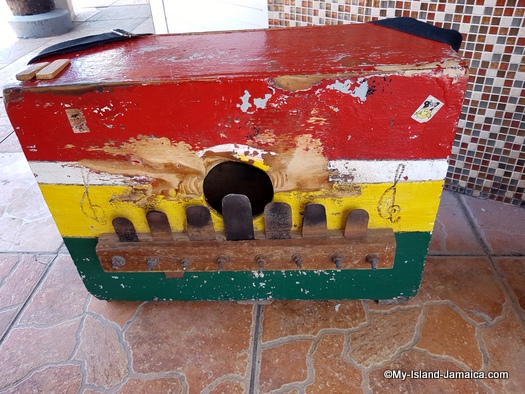
Old-Time Jamaican Instruments
We boast, through our motto that we are, "Out of Many, One People". And our musical instruments symbolizes this well.
New! How much do you love Jamaica?
Join our growing list of well-thinking Jamaica-loving folks who are demonstrating what a friendly, helpful and fun Jamaican community looks like. Click Here to learn more.
And, if you ever need a trustworthy and knowledgeable local guide, consider booking a private tour with us!
If you have already read the history of Jamaica or the culture of Jamaica, then you would have learnt about the unique blend of cultures and traditions that creates the real Jamaica.
We inherited instruments dating back as far as the Arawaks, the early inhabitants.
Of course, been a predominantly black population (over 90%), the majority of our musical instruments are originated from Africa, but we have invaluable input from the Chinese, Indians, Syrians and the Europeans - all of whom played integral roles in our historical development.
Below I'll highlight some of the more popular instruments, categorized by the different ethnic groups.
The Arawaks (Tainos)
The Arawaks contributed at least six (6) musical instruments. These include the:
- Large Drums
- The Flute
Including one made of bone! Although not much was said of what type of animal, especially since the animals in Jamaica were all small.
It is theorized that perhaps the said bone was that of the Caribs, their enemies who were thought to be much fiercer than the Arawaks. - Aeolian Harps
- Tabors (small drums)
was evidently as small drum. - Trumpet
- Timbrels or Tambourines
The African Descendants
Our African ancestors contributed quite a lot. These may be categorized into four classes:
- Percussions (Drums)
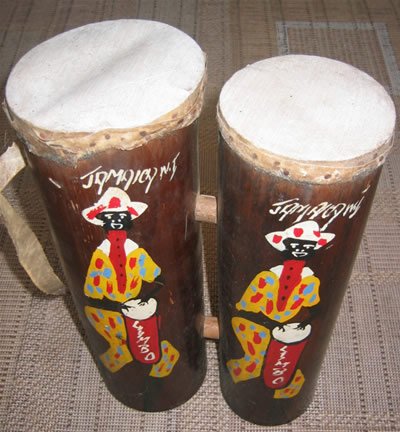
Drums varied in shape, size, according to to tribal fashionGumbieBarrel Shaped, about 6 ft in length. Made form pieces of hallow trees.GoombahA hollow block of wood.
GoombayA rustic drum formed from the truck of a hallow tree.All covered with skins of goats or sheep. - String (Rough Guitars)
A fair variety made of wood or gourds. Eg. Fiddles, Bangils, banjar – has little to do with the banjo of today, bender- probably so name because it was made of a stick bent bow shaped and kept thus by a slip of dried grass. - Wind (Flutes)
The only was discovered then was the Coromantee flute, named after the fierced Coromantee African tribe. - Non Descript (Rude Instruments)
There is the Jenkoving- two jars with medium size mouth over which the performer brought down their hands and the Kitty-Katty, a flat piece of board on which they beat with two sticks.
Rattles or boxes or small sized calabashes, filled with pebbles or Indian shot seeds were also used.
Sometimes they were made with a handle and were shaken by the hand of the performer used or sometime, at other times they were tied to legs or wrist and as they dance or sang, making a noisy accompaniment.
There was also the Rookaw – two jagged sticks.
The Maroons
Although also African descendants, the maroons were singled out because of their independence.
They have many musical instrument but their ‘national’ instrument is the Abeng.
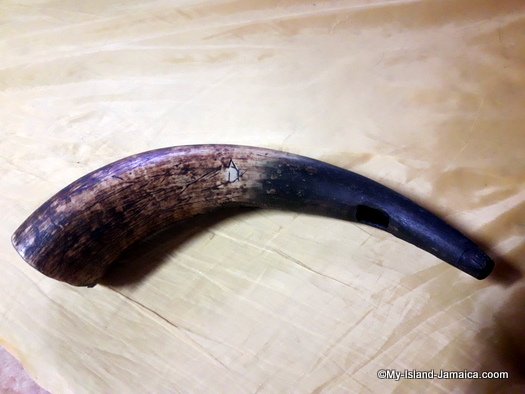
It made from the cow’s horn and can safely be assumed that it did not come from the aboriginal period, as the cow was introduced in Jamaica by the Spaniards sometime after 1509.
It is made of 8 or 9 inches of the small end of the cow’s horn. A sufficient part of the tip is taken off leaving a small hole about the size of a pea.
On the concave side of the horn and close to the smaller end,an oblong opening or mouth-hole is made.
This is about ¼ of an inch wide and about an inch in length.
There is also use a drum called Toombah, a large piece of the trumpet tree, hallowed out. Three strings are then stretched across.
The vast majority of these are primitive, very primitive, but no doubt they set the stage for today's complex and elaborate musical instruments.
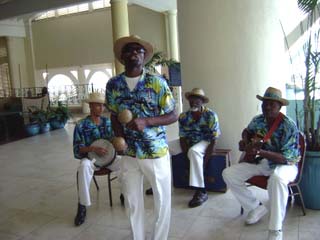
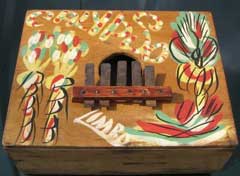
By the way, particularly in our traditional mento music, the Banjo, Guitar, Marimba or Rhumba box (seen above), and double bass percussion instruments such as triangles, pieces of iron, empty sardine cans, as well as forks and graters are also used - even today!
|
|
Sources:
- The music and musical instrument of Jamaica by Astley Clerk, published in 1913.
- DiverseHamilton.ca, http://www.diversehamilton.ca/americanCommunity/jamaican.html, Accessessed June 25, 2008
Pages Related To Jamaican Instruments
Still, lots to share with you from Jamaica, don't miss these informative pages:
- The History of Jamaica
- Jamaica's Culture
- Pictures from Jamaica
- Jamaican Proverbs
- Current Events in Jamaica
- Our Jamaican Blog
- Visit my Main Forum Page from Jamaican Instruments
Back to Top of Jamaican Instruments
Return to Jamaica Culture from Jamaican InstrumentsReturn to My Island Jamaica Homepage from Jamaican Instruments
New! Get My Latest Book👇🏿
 |
You asked, I've answered! You no longer need to save for months or years, to enjoy paradise! I spilled the beans! sharing my top tips on finding cozy accommodations and secret gems, only the way a native could! Click Here to pick it up on my e-store and start saving now! |
See The Best Of Jamaica - In Videos!
 |
My channel reaches over 140,000 subscribers worldwide and has leveraged over 11 million views, sharing, what I call 'The Real Jamaica'. Subscribe today and join our family of viewers. |

Read More ...
New! Experience The REAL Jamaica!
Book Your Private Tour here and experience Jamaica the way we (locals) do!
P.S. Didn't find what you were looking for?
Still need help?
Click Here to try our dependable and effective Site Search tool. It works!
Or, simply click here and here, to browse my library of over 500 questions and answers! Chances are someone already asked (and got an answer to) your question.






NEW!
Join the growing list of well-thinking, Jamaica-Loving folks in our vibrant Private Community
👇🏿

Featured Video!

Travelling To Jamaica?
Read this BEFORE you go
👇🏿
New Here?
I recommend you START HERE to enjoy the best of this website!
New! For Authentic Jamaican products, from my very own hands, visit my Etsy store here.
Recent Articles


-
Medical Scholarships in Jamaica
Apr 23, 24 04:21 PM
 Pursuing a career in medicine is a noble aspiration, however it is quite expensive. These medical scholarships in Jamaica helps to ease the financial burden.
 -
Why Do People Like Jamaica So Much?
Apr 23, 24 03:00 PM
 Jamaica is one of the top vacation destinations in the Caribbean, which may have you wondering, why do people like Jamaica so much?
 -
How To Become A Realtor In Jamaica?
Apr 20, 24 12:09 PM
Are you eyeing the real estate business but not sure how to become a realtor in Jamaica? This is all you need to know to get started. -
Jamaican Oats Porridge Recipe! Simple and Delicious
Apr 19, 24 01:49 PM
 Yes! Oats porridge, the breakfast of champions! This simple dish is a go-to for most of us. Don’t you want to give the Jamaican Oats Porridge recipe a try?
 -
Jamaican Passion Fruit Juice | Refreshing, Delicious, Nutritious!
Apr 18, 24 05:14 PM
 Summer is fast approaching. We’ll need many refreshing drinks to take through the warm sunny weather. Why not add Jamaican passion fruit juice to the list?




About The Author

A patriotic Jamaican who adores its culture, Wellesley has been using this medium to share what he calls 'the uniqueness of Jamaica with the world' since April 2007.
To date, he serves over 9,300 unique readers / viewers per day (and over 1.1millon page views monthly)
His efforts have earned this site featured positions in local publications, including the Jamaica Gleaner's Hospitality Jamaica, Carlong Publishers, as well as recognition from numerous prestigious international agencies and universities. Read more about him here.
He invites you to subscribe to this site to stay updated on all the latest and check out his unique Jamaican products on his e-store.
If you are on social media, here are the links to follow his latest posts:
You are also invited to join his exclusive JAMHearts community where like-minded Jamaican enthusiasts discuss all things Jamaican.
Didn't Find What You Are Seeking?
Do a quick site search here:
New! Comments
Have your say about what you just read! Leave me a comment in the box below.