Subscribe for all my updates and don't miss a thing! Sign me up!
The Beautiful & Unique
Jamaican Caper Plant
Sharing Is Caring! Share this awesome content with your friends now.

New! See the real Jamaica in VIDEOS!
Click Here and see why over 140,000 fans are raving about my YouTube Channel!
Jamaican Caper
by Rosemarie Gordon-Cole
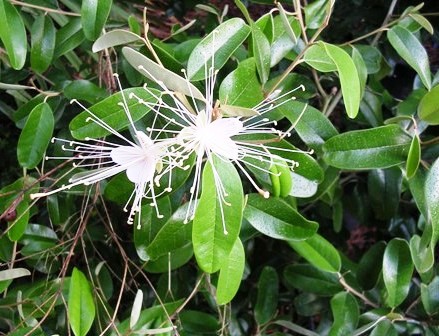
‘Perfect’ is one of the words used to describe this unique plant. It is unique in that it has all the components needed to fertilize its own pollens!
New! How much do you love Jamaica?
Join our growing list of well-thinking Jamaica-loving folks who are demonstrating what a friendly, helpful and fun Jamaican community looks like. Click Here to learn more.
And, if you ever need a trustworthy and knowledgeable local guide, consider booking a private tour with us!
This is possible as the Jamaican Caper is one of the few plants with both male and female components.
And with a little help from the wind, insects, animals or even us humans the J'can Caper is able to do its thing ensuring that its species will always be around.
 |
A 3 – 10 inches brown pod appears after fertilization takes place and this is normally seen between July and September. When mature these pods are deep red and split open to show the seeds surrounded by a thick sticky substance which is a favorite with the birds.
Capparis Cynophallophora is the scientific name given to it. The origin of this tree like shrub is unknown but can be found in the following areas:
- South America
- Central America
- Parts of Mexico
- The Caribbean
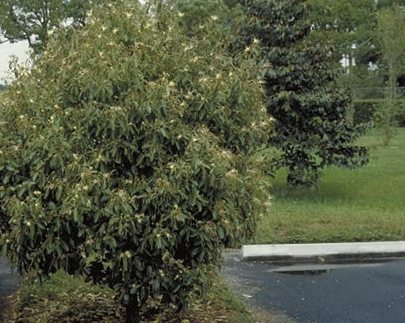
This salt and drought tolerant plant is perfect for hedging. The mature plant is approximately 6 - 30 feet tall, very thick and has a pyramidal shape which makes it the perfect plant to use for blocking out that view you have been dying to hide. They can however be trimmed to stay at 4 to 5 feet tall.
Here are some additional characteristics of the JamaicanCaper:
- Multicolored leaves, green on top with a hairy brown beneath
- loves full sun or partial shade
- ideal for sandy or limestone soils
- Orchid-like flowers opens only in the evening and turns lavender when hit with the morning sun. Blooms last for only 24 hrs.
- Flowers give off a sweet fragrance in the evenings. Flowering normally happens between April and July.
If you are not able to get a seedling from under a parent tree you can try any of the two methods below.
Seeding
The ideal spot to start seedlings is a compost heap. The compost heap has the right temperature and moisture that make it the perfect environment for germination to take place. Within two to three weeks you should start seeing the emergence of saplings. Transplant when the plant is hardy enough to move.
Stem cuttings
If this is your choice of propagation it is best to cut from the base of the stems, which would leave you with buds and smaller stems. Even though this is a drought tolerant plant, in-order for the cutting to catch they will need to be watered at least once a day.
See Also: Jamaican Flowers
Return to Jamaican Flora & Fauna from Jamaican Caper.
Return to HomePage from Jamaica Caper.
Posted: 02/10/2012
Pages Related To Jamaican Caper
Make sure you subscribe to my free monthly e-zine My Island Jamaica Digest (MIJD) and stay with the latest from Jamaica!
New! Get My Latest Book👇🏿
 |
You asked, I've answered! You no longer need to save for months or years, to enjoy paradise! I spilled the beans! sharing my top tips on finding cozy accommodations and secret gems, only the way a native could! Click Here to pick it up on my e-store and start saving now! |
See The Best Of Jamaica - In Videos!
 |
My channel reaches over 140,000 subscribers worldwide and has leveraged over 11 million views, sharing, what I call 'The Real Jamaica'. Subscribe today and join our family of viewers. |

Read More ...
New! Experience The REAL Jamaica!
Book Your Private Tour here and experience Jamaica the way we (locals) do!
P.S. Didn't find what you were looking for?
Still need help?
Click Here to try our dependable and effective Site Search tool. It works!
Or, simply click here and here, to browse my library of over 500 questions and answers! Chances are someone already asked (and got an answer to) your question.






NEW!
Join the growing list of well-thinking, Jamaica-Loving folks in our vibrant Private Community
👇🏿

Featured Video!

Travelling To Jamaica?
Read this BEFORE you go
👇🏿

New Here?
I recommend you START HERE to enjoy the best of this website!
New! For Authentic Jamaican products, from my very own hands, visit my Etsy store here.
Recent Articles


-
Seville Great House Jamaica | Historical Site And Park
Apr 26, 24 12:52 PM
 Ahh, the Seville Great House Jamaica. The building holds great significance to Jamaican history and culture, so why not take a look around yourself?
 -
How Much Is Property Tax In Jamaica?
Apr 25, 24 08:46 PM
 Purchasing your own land is a major accomplishment but the thought of paying property tax can be daunting. How much is property tax in Jamaica by the way?
 -
How To Apply For An H2B Visa In Jamaica?
Apr 25, 24 02:07 PM
 For many Jamaican locals and H2B visa is the key to their dreams. Ready to take on that journey? This is how to apply for an H2B visa in Jamaica.
 -
Medical Scholarships in Jamaica
Apr 23, 24 04:21 PM
 Pursuing a career in medicine is a noble aspiration, however it is quite expensive. These medical scholarships in Jamaica helps to ease the financial burden.
 -
Why Do People Like Jamaica So Much?
Apr 23, 24 03:00 PM
 Jamaica is one of the top vacation destinations in the Caribbean, which may have you wondering, why do people like Jamaica so much?




About The Author

A patriotic Jamaican who adores its culture, Wellesley has been using this medium to share what he calls 'the uniqueness of Jamaica with the world' since April 2007.
To date, he serves over 9,300 unique readers / viewers per day (and over 1.1millon page views monthly)
His efforts have earned this site featured positions in local publications, including the Jamaica Gleaner's Hospitality Jamaica, Carlong Publishers, as well as recognition from numerous prestigious international agencies and universities. Read more about him here.
He invites you to subscribe to this site to stay updated on all the latest and check out his unique Jamaican products on his e-store.
If you are on social media, here are the links to follow his latest posts:
You are also invited to join his exclusive JAMHearts community where like-minded Jamaican enthusiasts discuss all things Jamaican.
Didn't Find What You Are Seeking?
Do a quick site search here:
New! Comments
Have your say about what you just read! Leave me a comment in the box below.